
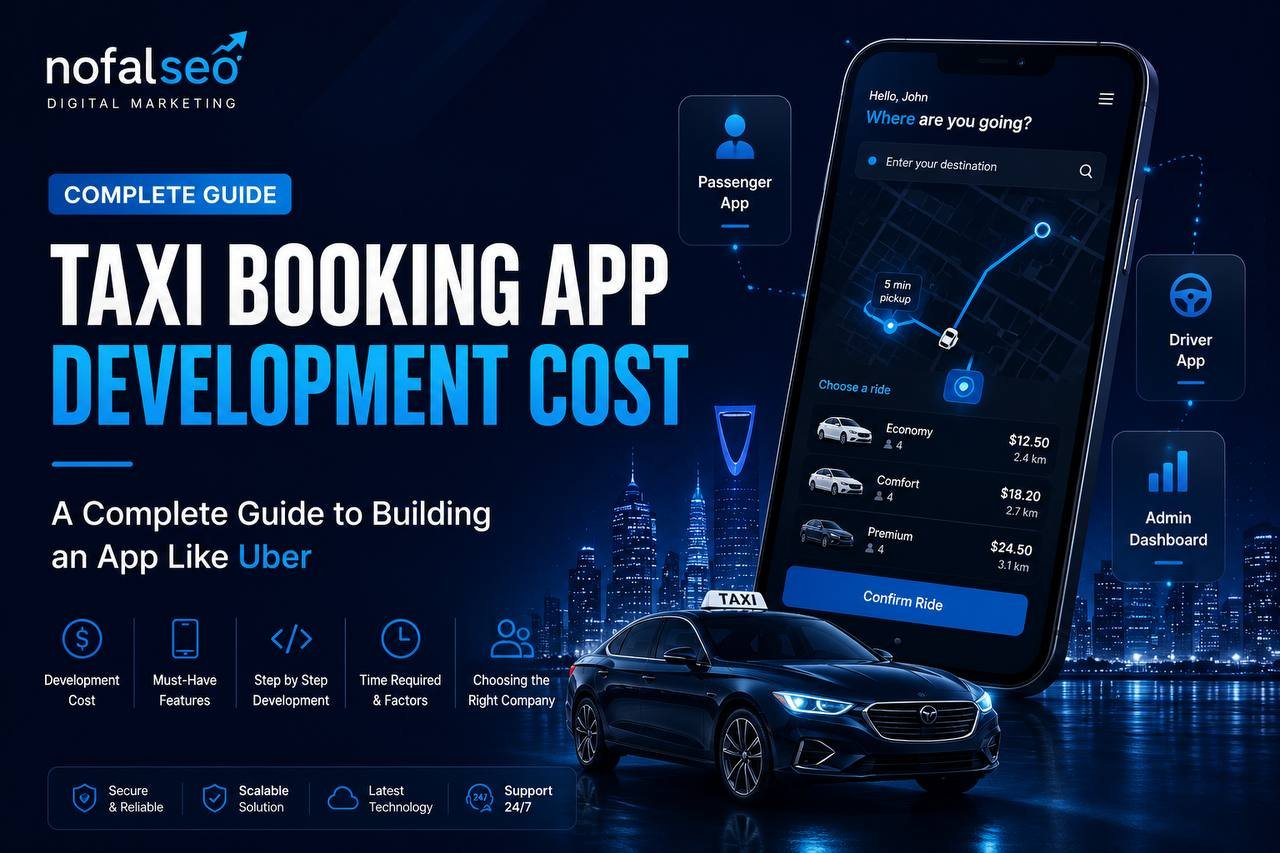
Taxi Booking App Development Cost: How to Build an App Like Uber in 2026
Book a Free Consultation Now
Would you like to know more about this topic?
Contact us on WhatsApp and get a free consultation from our experts
Contact on WhatsApp NowTaxi App Development Guide 2026
Taxi Booking App Development Cost: How to Build an App Like Uber in 2026
A complete guide for founders, taxi companies, transport operators, and investors who want to understand the real cost, features, timeline, and strategy behind building a profitable ride-hailing platform.
Last updated: August 6, 2026
Quick Cost Summary
Taxi booking app development cost in 2026 usually depends on the business model, feature depth, number of apps, technology stack, design quality, integrations, and whether you choose a white label taxi booking app or custom taxi app development.
- White label taxi booking app: from $3,000 to $15,000 for a fast launch with ready-made features and branding changes.
- MVP taxi booking app: from $12,000 to $35,000 for rider app, driver app, admin panel, GPS tracking, basic payments, and notifications.
- Custom Uber-like app development: from $35,000 to $120,000+ depending on advanced features, scalability, real-time tracking, dashboards, automation, and multi-country requirements.
- Enterprise ride-hailing platform: $120,000 to $300,000+ for large fleets, multiple cities, complex dispatching, corporate accounts, analytics, compliance, and high-load infrastructure.
At NofalSEO, we help businesses launch taxi booking apps with a practical roadmap: start with the right MVP, reduce unnecessary cost, validate the market, then scale with features that actually improve operations and revenue.
What Is a Taxi Booking App?
A taxi booking app is a digital platform that connects passengers with nearby drivers in real time. The passenger selects a pickup location, enters a destination, sees an estimated fare, books the ride, tracks the driver on the map, pays by cash or card, and rates the trip after completion.
Behind that simple experience, a professional taxi booking platform includes several connected systems: a rider app, a driver app, an admin panel, a dispatch dashboard, a backend server, maps and GPS APIs, payment gateways, notifications, fare calculation, trip management, reviews, support tools, and analytics.
That is why the question is not only “how much does it cost?” The better question is: how to build a taxi booking app that is reliable, scalable, easy to use, and profitable in your target market?
Who Needs Taxi Booking App Development?
Taxi booking app development is suitable for many business models, not only startups trying to copy Uber. You may need a ride-hailing platform if you are:
- A local taxi company that wants to replace phone bookings and WhatsApp dispatching.
- A limousine, chauffeur, or airport transfer company.
- A fleet owner managing drivers and vehicles across one or more cities.
- A startup planning to launch a niche ride-hailing service.
- A transport company serving employees, schools, hotels, or corporate clients.
- A business targeting premium rides, women-only rides, family transportation, medical transport, or tourism transfers.
- An entrepreneur searching for how to build an app like Uber without wasting budget on the wrong features.
Taxi Booking App Development Cost in 2026: Detailed Breakdown
The cost of building a taxi app can vary widely. A simple branded app based on a ready solution is very different from a fully customized ride-hailing ecosystem built for multiple countries. The table below gives a practical cost range for planning.
| Project Type | Best For | Estimated Cost |
|---|---|---|
| White label taxi booking app | Fast launch, lower budget, standard taxi features | $3,000 – $15,000 |
| MVP ride-hailing app | Startups validating a city or niche market | $12,000 – $35,000 |
| Custom taxi booking app | Businesses needing unique workflows, branding, and scalability | $35,000 – $120,000+ |
| Enterprise Uber-like app development | Multi-city operations, large fleets, advanced dashboards | $120,000 – $300,000+ |
These numbers are planning estimates. Your real ride hailing app development cost depends on the number of platforms, design complexity, user roles, integrations, payment options, admin features, support requirements, and how much customization you need.
Why Taxi App Development Cost Changes From One Project to Another
Two companies may ask for “an app like Uber” and receive completely different quotes. The reason is simple: Uber is not one screen or one app. It is a complete operating system for transportation. Your cost changes based on the depth of that system.
1. Number of Apps and Dashboards
A basic project normally includes a rider app, a driver app, and an admin panel. A larger project may also require a dispatch panel, partner dashboard, fleet owner portal, customer support dashboard, corporate booking panel, and web booking interface.
2. iOS, Android, or Cross-Platform Development
If you build separate native apps for iOS and Android, the cost is usually higher. Cross-platform development using technologies such as Flutter or React Native can reduce development time for many MVPs, while still delivering a strong mobile experience when built correctly.
3. GPS Tracking and Maps
Real-time tracking is one of the most important taxi booking app features. The app must detect pickup and drop-off locations, track drivers, calculate distance, estimate arrival time, update trip status, and support navigation. This requires careful integration with maps, GPS, geolocation, and backend events.
4. Fare Calculation and Pricing Logic
A professional taxi app needs flexible pricing: base fare, distance fare, time fare, minimum fare, waiting charges, cancellation fees, peak pricing, zone-based pricing, vehicle type pricing, promo codes, and commissions.
5. Payment Integrations
Your app may support cash, credit cards, Apple Pay, Google Pay, wallets, bank transfer, corporate invoicing, or local payment gateways. Each payment method adds setup, testing, security, and compliance work.
6. Admin Panel Complexity
The admin panel is the control center. It manages riders, drivers, vehicles, documents, trips, payments, coupons, commissions, complaints, notifications, reports, and system settings. A weak admin panel creates operational problems even if the mobile app looks good.
7. Security, Compliance, and Scalability
Taxi apps handle sensitive data: names, phone numbers, locations, trip history, driver documents, and payment data. Secure authentication, role permissions, encrypted communication, server protection, backups, and monitoring are essential.
Core Taxi Booking App Features
If you are searching for taxi booking app features, focus first on the features that support booking, trust, safety, and operations. Nice-to-have features can come later after real users start using the platform.
Rider App Features
- Phone, email, or social login
- Pickup and destination selection
- Fare estimate before booking
- Vehicle type selection
- Live driver tracking
- Cash and online payments
- Promo codes and offers
- Trip history and invoices
- Driver rating and reviews
- In-app support and complaints
Driver App Features
- Driver registration and document upload
- Online/offline availability
- Ride request alerts
- Accept or reject trips
- Navigation and route view
- Trip status updates
- Earnings dashboard
- Wallet and withdrawal requests
- Passenger contact options
- Ratings and performance summary
Admin Panel Features
- Manage riders, drivers, and vehicles
- Approve driver documents
- Monitor live trips
- Set fares, commissions, and zones
- Create coupons and promotions
- Manage payments and refunds
- Handle complaints and support tickets
- Send push notifications
- Generate financial reports
- Control staff roles and permissions
Advanced Features
- Scheduled rides
- Corporate accounts
- Fleet owner dashboard
- Surge pricing
- Driver incentives
- Multi-language support
- Multi-currency support
- Referral programs
- Safety SOS button
- AI-based demand analytics
How to Build a Taxi Booking App Step by Step
If you want to know how to build a taxi booking app, do not start with coding immediately. The best projects begin with strategy, market understanding, and a clear MVP scope.
Step 1: Define Your Business Model
Decide whether your app will serve public taxi bookings, private chauffeurs, airport transfers, women-only rides, premium cars, electric vehicles, corporate transport, tourism transfers, or local city rides. Your business model affects features, pricing, driver onboarding, marketing, and compliance.
Step 2: Study the Market and Competitors
Analyze Uber, Lyft, Bolt, Careem, local taxi companies, and regional competitors. Look for gaps: underserved cities, poor driver quality, high prices, weak support, lack of scheduled rides, lack of corporate plans, or poor coverage in specific neighborhoods.
Step 3: Choose MVP Features
The first version should include only the features needed to book, complete, pay for, and manage rides. Building too much too early increases cost and delays launch. A strong MVP helps you test the market faster and improve based on real data.
Step 4: Design the User Experience
The rider app must be simple. The driver app must be practical. The admin panel must be clear for operators. Good UI/UX reduces booking friction, support requests, and driver mistakes.
Step 5: Build Backend and APIs
The backend handles users, drivers, trips, pricing, payments, notifications, maps, documents, reports, and permissions. This is where scalability matters. A beautiful app with a weak backend will fail under real operational pressure.
Step 6: Develop Rider and Driver Apps
Your development team builds the mobile apps, integrates APIs, connects maps, configures payments, adds notifications, and tests the full booking journey from request to completion.
Step 7: Test Real-World Scenarios
Testing must include location accuracy, poor internet connection, driver cancellation, rider cancellation, failed payment, wrong pickup point, delayed arrival, refunds, coupons, and multiple simultaneous bookings.
Step 8: Launch, Measure, and Improve
After launch, track booking conversion, driver acceptance rate, cancellation rate, average waiting time, support tickets, payment issues, and repeat usage. These metrics guide the next development phase.
How to Build an App Like Uber Without Copying Uber Blindly
Many founders ask how to build an app like Uber. The answer is not to copy every feature. Uber is a global platform with massive scale. Your first goal should be to solve a specific market problem better than the existing options.
You can compete by focusing on a narrow segment: airport transfers, luxury rides, city taxi fleets, corporate transport, tourist transportation, family-safe rides, women-only rides, medical transport, or a local city that is not served well by large platforms.
The smartest Uber-like app development strategy is to launch with a focused version, prove demand, build supply from reliable drivers, improve service quality, and then expand gradually.
White Label Taxi Booking App vs Custom Taxi App Development
One of the biggest cost decisions is whether to choose a ready-made white label platform or build a custom system from scratch.
| Option | Pros | Cons |
|---|---|---|
| White label taxi booking app | Faster launch, lower cost, ready features, good for market testing | Less flexibility, limited customization, may not fit complex workflows |
| Custom taxi app development | Full control, unique features, stronger branding, scalable architecture | Higher cost, longer timeline, requires more planning |
A white label taxi booking app is ideal if you need a quick launch and standard ride-hailing features. Custom taxi app development is better if your business has unique operations, complex pricing, multiple markets, fleet owners, corporate clients, or long-term product ambitions.
Recommended Tech Stack for Taxi Booking App Development
The best technology stack depends on your budget, timeline, scale, and team. A typical ride-hailing system may include:
- Mobile apps: Flutter, React Native, Kotlin, Swift.
- Backend: Node.js, Laravel, Python, Java, or Go.
- Database: PostgreSQL, MySQL, MongoDB, or Redis for real-time performance.
- Maps: Google Maps, Mapbox, or local map providers depending on the country.
- Payments: Stripe, PayPal, Apple Pay, Google Pay, local gateways, or wallet systems.
- Notifications: Firebase Cloud Messaging, APNs, SMS, email, and WhatsApp integrations.
- Hosting: AWS, Google Cloud, DigitalOcean, Hetzner, or a managed cloud environment.
Taxi App Development Timeline
Timeline depends on project complexity. A white label app can be launched quickly, while a custom platform requires planning, design, development, and testing.
- Discovery and planning: 1–2 weeks.
- UI/UX design: 2–4 weeks.
- MVP development: 8–14 weeks.
- Custom full platform: 4–8 months.
- Enterprise platform: 8–12+ months depending on modules and integrations.
Hidden Costs You Should Plan For
The initial development quote is not the only cost. To run a taxi booking app successfully, you should also plan for:
- Cloud hosting and server monitoring.
- Maps and location API usage.
- SMS and push notification costs.
- Payment gateway fees.
- App Store and Google Play accounts.
- Maintenance, bug fixing, and OS updates.
- Customer support operations.
- Marketing, driver acquisition, and launch campaigns.
- Legal, insurance, and local transport compliance.
How Taxi Booking Apps Make Money
A ride-hailing app can generate revenue in several ways. The best model depends on your market, driver supply, and user behavior.
- Commission per ride: The platform takes a percentage from each trip.
- Driver subscriptions: Drivers pay a weekly or monthly fee to receive requests.
- Corporate accounts: Companies pay for employee transportation or monthly invoices.
- Premium vehicle categories: Higher margins for luxury cars or airport transfers.
- Ads and partnerships: Promotions inside the app when the user base grows.
- Fleet management fees: Tools for companies that manage multiple drivers and vehicles.
Why Choose NofalSEO as Your Taxi App Development Company?
Choosing the right taxi app development company matters more than choosing the cheapest quote. You need a team that understands mobile apps, backend systems, SEO, conversion, operations, scalability, and the business logic of transportation platforms.
NofalSEO has experience building digital platforms for transportation, booking, delivery, service management, and business automation. Our team can support you from idea validation and feature planning to design, development, launch, optimization, and growth.
We also understand markets where English search demand comes from both international and Arab-region users, including the United States, Europe, the Gulf, Saudi Arabia, UAE, Qatar, Kuwait, Egypt, and other regions where businesses search in English for professional app development partners.
Ready to Build Your Taxi Booking App?
If you want a practical estimate for your taxi booking app, do not guess the budget. Contact the NofalSEO team and tell us your target country, business model, required platforms, payment methods, and must-have features. We will help you choose the best path: white label, MVP, or fully custom Uber-like app development.
Contact our team today to discuss your project and receive a clear development roadmap.
Common Mistakes to Avoid
- Trying to build every Uber feature in the first version.
- Choosing a cheap script without checking code quality and scalability.
- Ignoring the driver experience.
- Launching without enough drivers in the target area.
- Using unclear fare rules that confuse passengers.
- Forgetting support, refunds, cancellations, and complaint management.
- Not budgeting for hosting, maps, SMS, and maintenance.
- Building the app before validating the business model.
FAQ: Taxi Booking App Development Cost
How much does taxi booking app development cost in 2026?
Taxi booking app development cost can start from $3,000 to $15,000 for a white label solution, $12,000 to $35,000 for an MVP, and $35,000 to $120,000+ for a custom Uber-like platform. Enterprise systems can exceed $300,000 depending on scale and complexity.
How to build a taxi booking app?
Start by defining your business model, target city, user roles, pricing rules, and MVP features. Then design the rider app, driver app, and admin panel, build the backend, integrate maps and payments, test real-world scenarios, and launch with continuous improvement.
How to build an app like Uber?
To build an app like Uber, you need a rider app, driver app, admin panel, GPS tracking, fare calculation, notifications, payment integration, ratings, trip management, and a scalable backend. Start with a focused MVP instead of copying every Uber feature.
Is a white label taxi booking app a good choice?
Yes, a white label taxi booking app is a good choice if you need a faster and cheaper launch. It is best for testing the market or starting with standard features. For unique operations and long-term scalability, custom development is better.
What are the most important taxi booking app features?
The most important features are user registration, pickup and destination selection, fare estimate, live driver tracking, ride requests, driver app, admin panel, payments, ratings, notifications, trip history, and support tools.
How long does Uber-like app development take?
A white label launch can take a few weeks. A custom MVP usually takes 8 to 14 weeks. A larger Uber-like app development project can take 4 to 8 months or more depending on features and integrations.
Can NofalSEO build a custom taxi booking app?
Yes. NofalSEO can help you plan, design, and develop a taxi booking app with rider app, driver app, admin panel, GPS tracking, payment integrations, reports, and scalable backend architecture. Contact the team to discuss your exact requirements.
Final Thoughts
Taxi Booking App Development Cost is not a fixed number. It depends on what you want to build, how fast you want to launch, how much control you need, and how large your business can become. A white label solution can help you start quickly. A custom platform can help you build a serious transportation business with long-term scalability.
If your goal is to build a reliable ride-hailing platform, focus on the core experience first: easy booking, accurate tracking, fair pricing, trusted drivers, simple payments, strong admin control, and excellent support. Everything else can grow in phases.
Ready to move from idea to launch? Contact the NofalSEO team and let us help you build a taxi booking app designed for growth.
Do you need a consultation about this topic?
Contact on WhatsApp